
First of all, let us explain for those who are not familiar with this definition. Performance Review can be loosely translated as an assessment of employee performance. This word makes many people's underbelly shake, but it's not a bad thing - it all depends on how you do it.
There are different ways to approach this matter, and today we are not going to teach you how to take tests, because depending on the specifics of the company, they are different for everyone. Let's go over the generalities of how the process should go, as well as what should never be done.
Why is it necessary
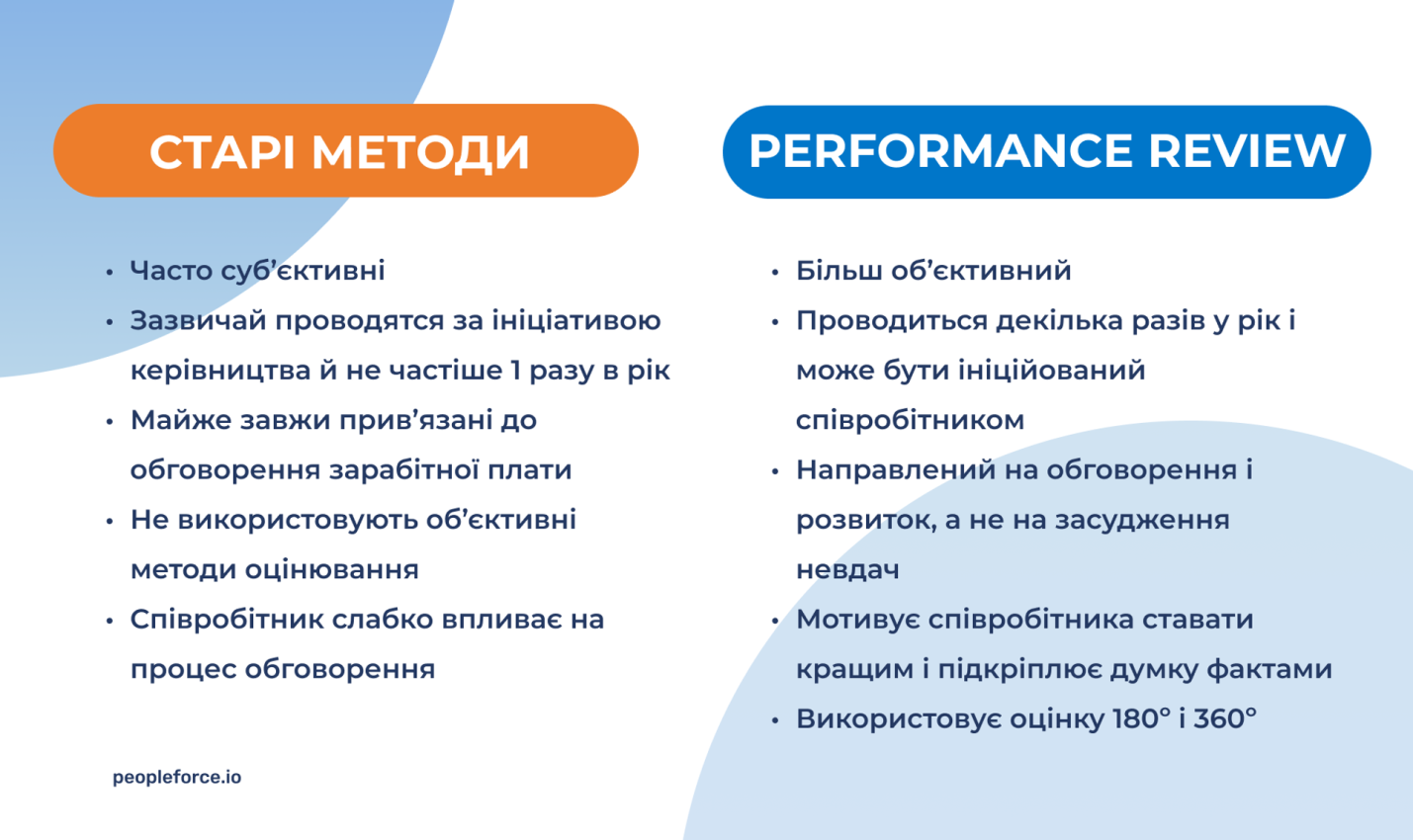
Many people will say, "that's how everything works for us anyway", or "I can assess everything at a glance". In fact, this is not true. Also, many managers consider this assessment to be an exclusively one-sided process, where they interrogate their subordinate like a partisan: "What did you do last year?". And this is also a misconception.
A well-done Performance Review is a way to improve the team's work as a whole and moral satisfaction among employees, they begin to see themselves not just as a "small cog" in the organisation, but as a valuable small (or not so small, depending on the position) cog without which nothing will work, even if it is a hybrid job for designers.
Since our review is usually process-oriented, we often notice certain slack spots that can lead to problems on the project (or maybe they already have, just while the participants are still enduring).
For companies, this is the main value - the earlier managers notice a problem, the easier it is to fix it. How exactly is always an individual question, but diagnostics would be more difficult without the right tool, which is Performance Review.

Employees will be much more open to dialogue and will not keep silent about problems, as they will see a sincere intention to improve their position in the company and help them grow professionally. Perhaps, for example, they need more flexible working hours.
How often should I conduct a Performance Review?
Many large companies, which are usually at the forefront of implementing new practices, used to conduct comprehensive staff assessments annually. However, there has been a recent trend of reducing the intervals between Performance Reviews.
There are many reasons for this, but the main one is the loss of relevance of the information collected. Much of what has happened over the past six months to a year may be forgotten, has already been resolved, or will be distorted (unintentionally) when respondents try to recall and describe events that are not of the first freshness. And in general, fresher events are much more valuable to employees and managers, even when working for students online.
Employees are most receptive to this practice when it comes at the end of a production cycle (release, client delivery, fiscal year end). For companies with fast-growing production (startups and companies with projects completed in a month), it's a good idea to conduct this practice every month. But don't take this as a strict recommendation, take into account your own specifics and timelines."
How to make a list of metrics
A mature business usually knows what behaviour of its employees leads to positive business results. The task of the Performance Review compiler is to split the business metrics into the process metrics of its employees.

If the company does not have carriers of quality criteria, do not be afraid to turn to employees. After all, in intellectual fields of activity, specialists themselves can effectively evaluate their work, especially when it is remote work without experience.
Ask the whole team what sub-processes are part of their standard workflow. For example, it can be:
- task setting
- cost and resource estimation
- execution
- testing
- product release.
Additionally, employees will tell you what they consider to be high, medium, and low quality of a process. Let's make a reservation right away - don't be afraid to be unconventional in this regard. Key business metrics don't always correlate with the generally accepted opinion of quality.
An example is the age-old problem of speed versus quality in the work of a developer: if you are in an environment where your customer values the speed of task completion more than quality, then it will simply be pointless to evaluate quality.
An important point: we don't recommend formulating these metrics as something tied to an employee. A good option for wording can be considered a question about the process and the employee's problems in it - and talk about them on a 1:1 basis based on the collected feedback.
How to formulate questions with examples
Again, we cannot give you a universal recipe. But here are some specific examples of how you can formulate questions in different types of employee activities to evaluate them from all sides.
For example, the question may be: "Are the requirements you have to work with clear and consistent enough?"
Answers:
- I have to extract requirements almost by force
- There are requirements, but they are always unstructured or even contradictory
- The requirements are clear, but we additionally clarify a small part of them in the course of work
- The requirements are always precise as a Swiss watch.
Or, for example, the question is already dedicated to the development process, if we have remote employment for programmers. We formulate it like this: "Is the code you work with clear? (you can choose several answers)"
- the code I write now is clear and simple
- the code I write now is quite difficult to understand, but this is its nature
- when I find my code in a month, it takes me an effort to remember why it works and how it works
- when I find my code in a month, it is elementary for me to remember how it works.
In general, the principle of building questions should be something like this. How to adapt this to the activities of your employees - you need to think specifically taking into account the specifics of the business.
Hear each other
It is also important to remember that a performance review is not a "debriefing" and a monologue of the manager! It is a dialogue on an equal footing between the manager and his employee. During such a dialogue, there should be an exchange of opinions. You should not just scold because "the deadlines were missed", but understand why this happened.

It is very important what the employee thinks about this. The manager may not have complete and exhaustive information. In the course of the dialogue, you should jointly get to the bottom of the reasons for not meeting tasks or deadlines and, if necessary, involve other employees of the organisation (for example, from related departments, etc.) who can provide more data to form a complete picture. After all, the reasons can be very diverse and do not depend on the employee. This is also true for cases when it's an online part-time job. If, for example, an employee lacks the qualifications or motivation to work effectively, it's not his fault!
An employee cannot be held responsible for their individual results if they depend on the work of other employees or departments. Did someone "constipate" the task, and the project as a whole did not meet the deadline? So what does our individual developer have to do with it if another department, such as designers, has messed up?
And another example. In your company, an employee is forced to follow outdated documents or methods ("because we've always done it this way"), and he can't do anything about it? And then you're going to blame him for failing to do something in today's realities? No, that's not the case.
In short, there can be many reasons. And in the process of discussion, the manager and the employee must come to a common understanding of what really hinders work and what to do about it. Only after the reasons for unsatisfactory results are understood, can final assessments be made. The final performance appraisals should be agreed between the manager and the employee.

Performance reviews should not be depressing or humiliating, but should bring clarity to the work, raise awareness, motivate and inspire employees to improve their performance. This is the meaning of Performance Review.
In general, the main point is not to reduce everything to "I'm the boss, you're the fool". When you talk as equals, the very facts of the meetings can be even more important than the results discussed.
That is, when you ask a person about the results, you don't use a checklist to apply sanctions to them if they "fail" or just a banhammer to fire them. First of all, you need to understand WHAT hasn't been done and WHY, what led to this, even if it was work from home.
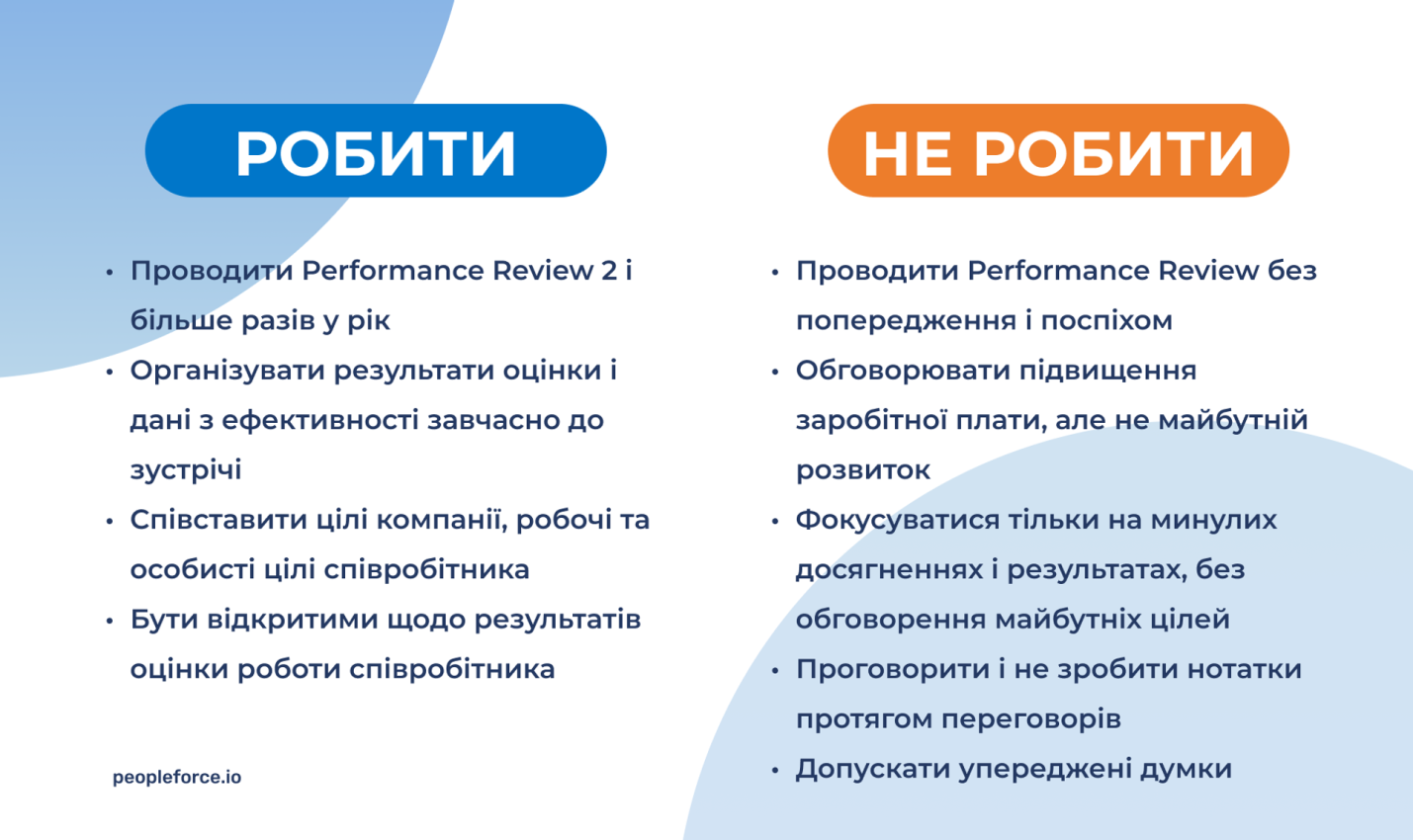
But this requires quality feedback, not just notifying employees of their achievements. Only then will Performance Reviews be an indispensable and important element that will support and help your business, not just annoy your employees.