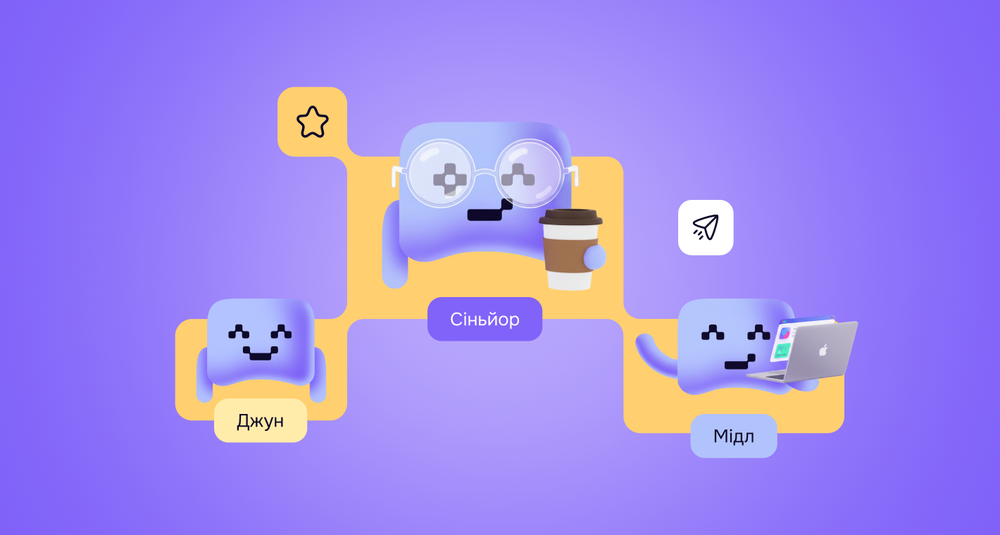
Reading articles about how to "enter IT", you have definitely come across these three words. Perhaps you even decided for yourself that this is a kind of gradation - from the least experienced employees to more or less savvy ones, and, accordingly, their guru-managers, as well as a reflection of their positions in the company.
In fact, all this is only part of the truth. First of all, this is a gradation of skills of certain employees, the level of their professional skills. Below, we will talk about these three categories and what they mean, as well as whether it is possible to rise above the level of a senior.
Who is a junior
In IT (and not only there), a junior is a beginner with minimal or no experience in the specialty. A junior is more of a theorist than a practitioner: he may know the theory perfectly, but has little understanding of how to apply this knowledge in his work. Therefore, it is not surprising that remote work for IT specialists most often involves the position of a junior.
But with little experience, he should be able to implement narrow technical tasks without any questions when the task is clearly outlined. For example, if you are assembling a cabinet with a company and you are instructed to screw the screws in the designated places with a screwdriver, congratulations, you are a junior in this process.

Juniors lack product thinking and soft skills, skills that can only be acquired with experience. For example, a novice specialist does not yet know how to build relationships with colleagues so that the work is smooth and communication is not toxic.
Often, juniors in a company perform simple, specific technical tasks set by a senior specialist. For example, to implement a single functionality with specific restrictions. If a junior doesn't understand something, he or she first tries to find the answer on his or her own, and then goes to a midle or a senior for advice.
Juniors rarely work without close supervision from middles, they are assigned relatively small tasks, or tasks where their task is to create purely technical code that does not require any analytical work.
In the past, juniors had an easier time of it, they were offered additional training in companies, etc. Now the competition is such that in order to apply for online vacancies in Ukraine, you need to have a very wide range of technical skills.
What a junior specialist should be able to do
The fact is that the requirements for juniors have increased in recent years. There are a lot of novice developers on the market because online courses are available to everyone, and new remote employment for programmers will be available in 9 months. Therefore, companies began to expand the list of requirements for junior developers to hire the best ones.

If a front-end developer as a beginner had to know only JavaScript, HTML, or CSS3 by heart, today, in addition, you need to be confident in working with one of the frameworks, for example, React or Angular (or better yet, both!). Most likely, in the future, the requirements will become even more serious, because competition is growing, and here artificial intelligence is also stepping in.
Hard skills, or professional skills of juniors, may differ depending on the specialisation. For example, it is important for a novice web developer to be able to use various graphic editors, while a PHP programmer, on the contrary, needs to know different CMS.
In general, if you want to apply for the position of a junior developer, remember three main things:
- be ready to constantly learn and develop as a specialist
- calmly accept criticism and learn from your own mistakes
- you also need to learn to work in a team
The last point is very important. You must be able to balance what you have to do yourself and when it is better to ask for help from more experienced colleagues. A good junior should be productive and not make excuses for being a beginner."
Who is a Middler
When a specialist gains experience, delves into the nuances of the company's work, confidently uses the necessary tools in his work, namely programming languages, frameworks, database management systems, etc. In addition to the technical skills, you also need to understand why things are done this way and not otherwise.
Middle is an experienced specialist who writes code in projects. He knows several programming languages and knows how to use additional technologies. For example, a backend developer also knows Angular, a web application development framework, and can solve the tasks of a frontend developer.

Middle can easily explain complex things in their own words. For example, how a browser works or what asynchrony is. His code is no longer checked because he knows the language he writes in well and understands the basic concepts. Middle controls himself: he corrects the logic and looks for errors in the code to make it more readable and simple. But it's not all about the code.
Middle decides how to complete tasks easier and faster, and plans deadlines. He can offer several unconventional solutions, not just one or two standard ones, like a junior developer. Middles have the experience, expertise, and supervision that a junior lacks."
What a Middle Specialist Should Know
The development of a company rests on middles, so employers are very reverent towards them. They won't fire a mid-level specialist for no reason, on the contrary, they will do everything possible to keep him/her working and improve their skills.
There are not many strong middles on the market, so finding a job at home is not a problem for them. But, as in the case of juniors, the requirements for middles have become more serious. A few years ago, the skills and knowledge requirements were the same as for a senor.
But the main feature of a middles is not even certain qualifications in code, as you might think. He already understands business processes, and that is why he knows how to set tasks and choose the direction of the solution, conditionally, why we need this application, or "for whom" we are developing the site and what will be more relevant for users. This experience can be gained only over time, so no matter how technically "savvy" you are, you won't be hired as a mid-level developer right away, even if you know all the languages and codes of the world.
Who is a senior developer
The mid-level position is sometimes the last step on the career ladder, but not always. This is usually a specialist with extensive experience who already knows all possible technical solutions and manages the work of the development team.
Of course, a senior should be able to write good, clean code, but this is not the main thing for him. The most important thing is to choose the right technological solution to take into account the specifics of the company and its tools. He has a deep understanding of architecture, libraries, frameworks, and development tools.

There is a widespread belief that a señor should be able to fix any code or task himself, but this is not his level at all. In international practice, someone who can do all of this is called a "strong-minded".
Senior needs good communication skills because he must not only offer the right solution but also convince the customer and the team that he is right. Such a specialist will cope with tasks that he has never done before, and at the same time will not break or slow down anything.
If a senior wants to develop further in his career, he will need to learn how to solve business problems, even poorly formulated ones. He/she constantly communicates with the management, team, and clients and knows how to interact with each of them to ensure that the project leads to the desired result.
For example, a client wants to create a service for travellers to book accommodation. The client will first figure out what the purpose of such a service is, what problem it should solve. And then he will assemble a team, formulate and distribute tasks to juniors and middles, monitor the development and deadlines, and present the result to the client.
What a senior developer should be able to do
You can't become a senior developer just because of your work experience. The main thing is the level of expertise, the way of thinking, and soft skills. Programming is not the main thing for him, he knows how to do it, but he does it only in rare cases, the main thing here is managerial work.
Experience in commercial projects is important for a senior. A perfect knowledge of theory and projects done "for yourself" will not be enough to understand how real products in demand on the market are actually created.

Is the position of a senor final
Not at all! There is an opinion that after seniors, one must be promoted to team leaders. This is not entirely true, team leader is only one of the options for career development, although it is quite likely. Here are a few examples of development that are usually not so obvious.
- Many people become project managers. This is a "sideways" development, so to speak, because in this position, you no longer have to deal with code, but mainly with planning and people and organising their work.
- Another good option would be the position of a frontman. These are people who have the task of telling about the team and its experience, skills, and generally revealing technically complex things in simple words. The frontman can talk to both the customer and the technical team. A great front person should combine technical skills with presentation skills, and here the experience of working as a senor will be a good platform to start."
- The position of project architect can also be the next step in your career. The fact is that an architect must also be able to analyse the client's business and at the same time have a good understanding of the entire technical component. Based on this knowledge, the architect chooses a platform for creation not based on fashion trends, but on the effectiveness for a specific task.
You can also delve into something more specialised, for example, become a technical expert if you are a deep expert in a certain field. Such people are not needed as often as middles or seniors, but when they are, they are paid higher and the competition is lower. So, remember - there is always room for development, you just need to want it.